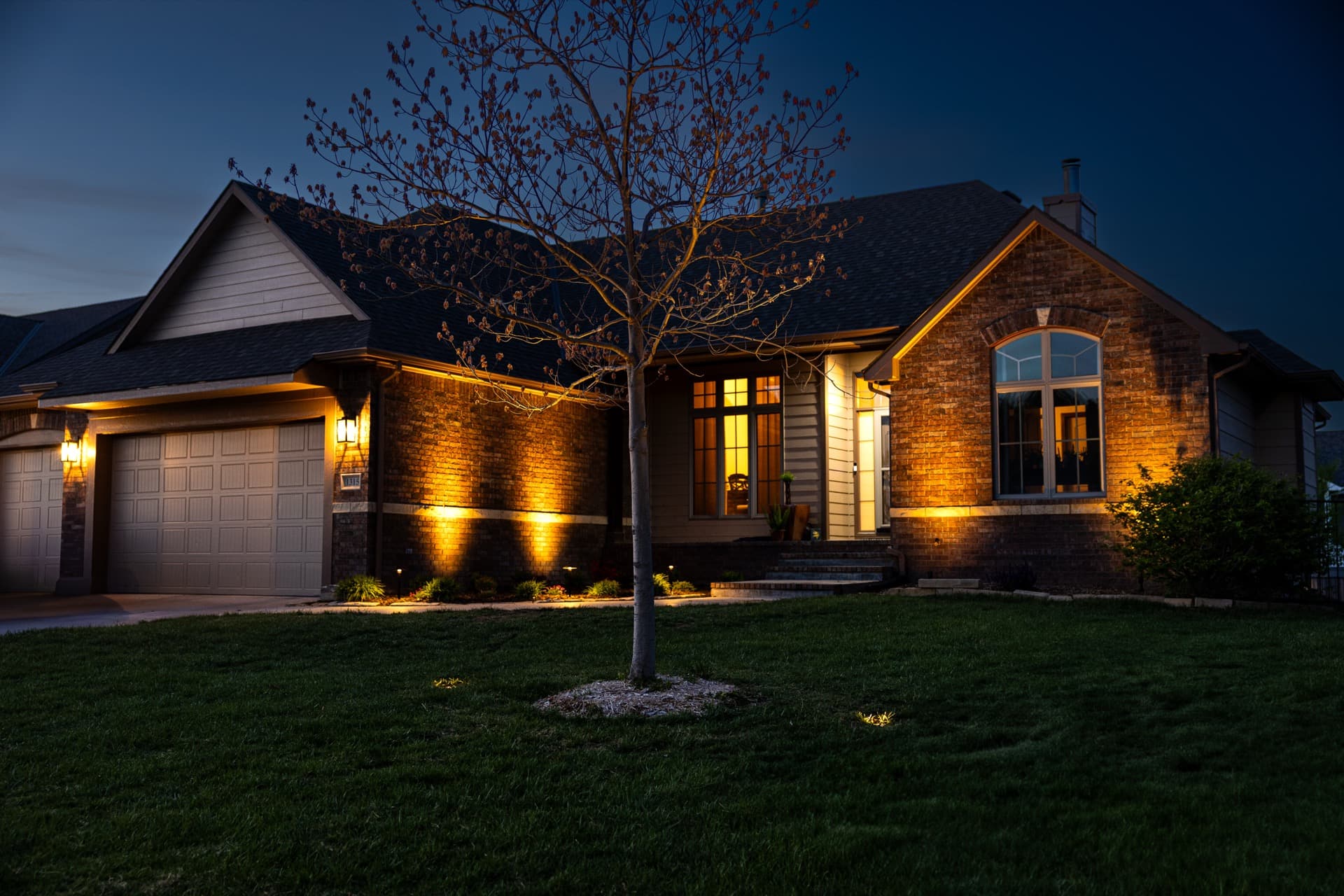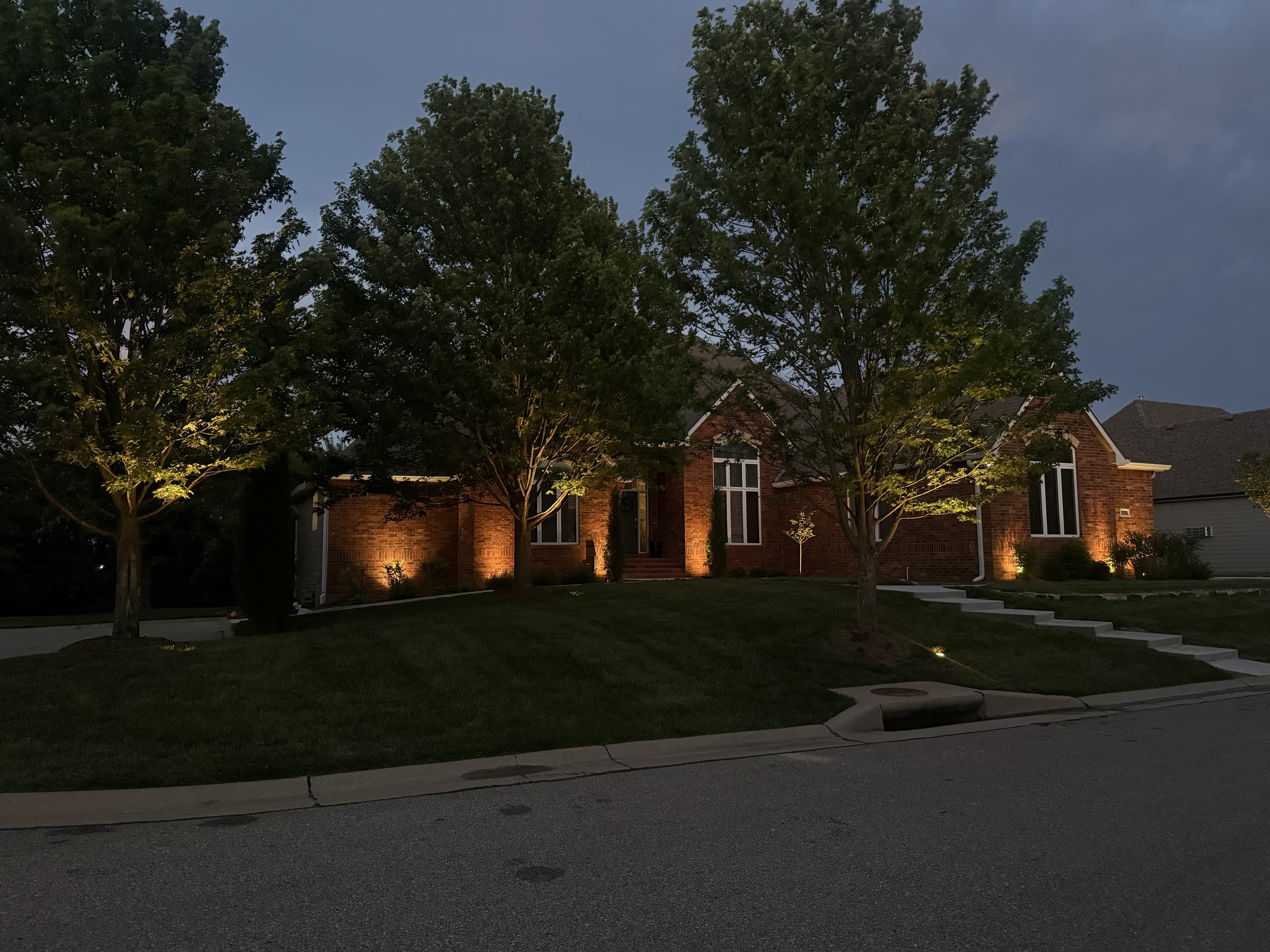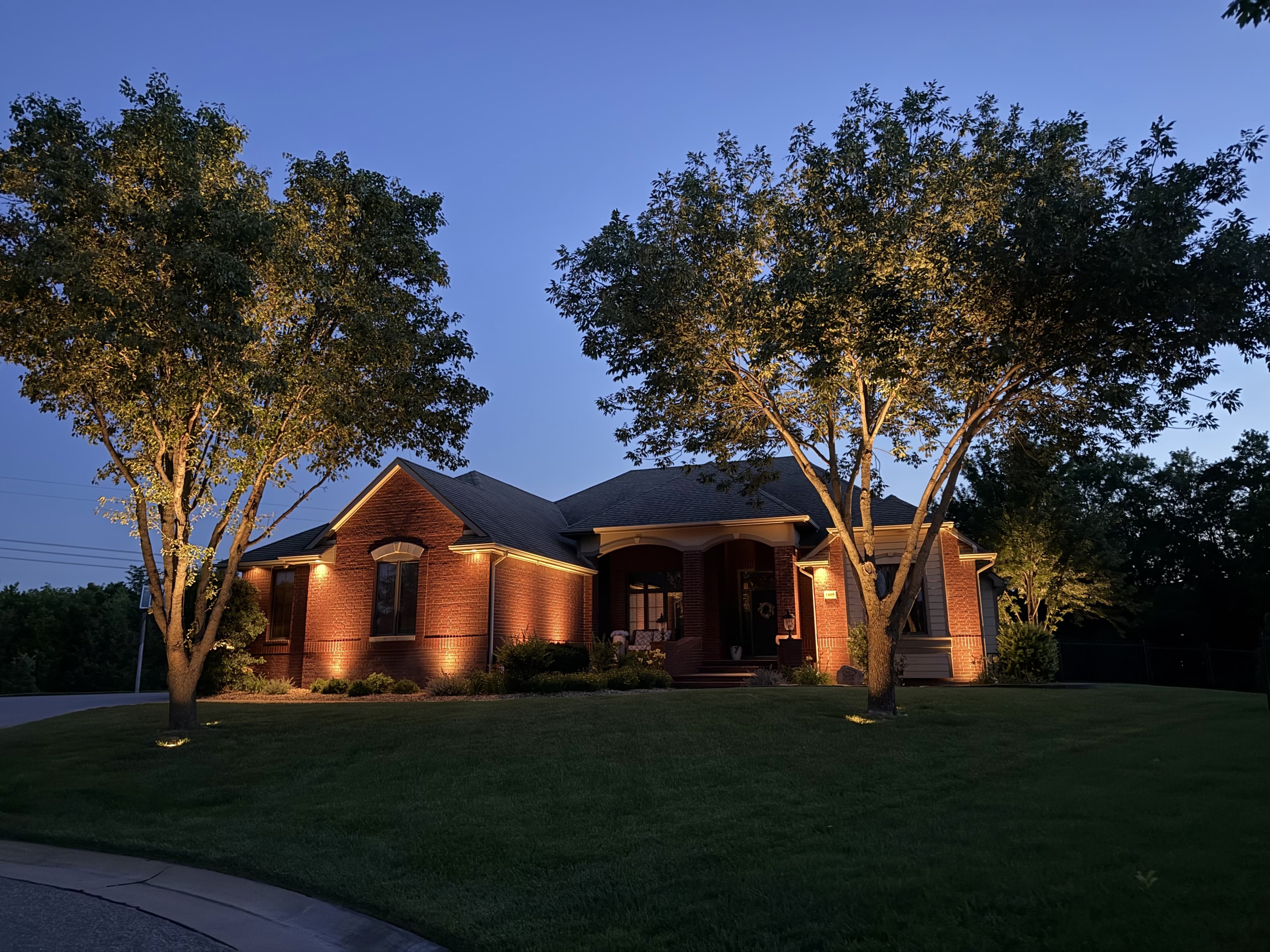
Most homeowners do not need to memorize fixture names. You just need to know what you want to see, where you need to walk, and how you want the property to feel after dark. The fixture is simply the tool that gets us there.
Start with the job, not the fixture
When we walk a property, we are not thinking, “Where can we put ten lights?” We are looking for the pieces that give the property its shape: the front entry, a brick column, a mature tree, the curve of a path, or the edge of a patio.
Once those priorities are clear, choosing the fixture becomes much easier. A good plan usually uses a few fixture types together, with each one doing a specific job.
Uplights: for architecture, trees, and height
Uplights sit at ground level and throw light upward. We use them to bring out brick texture, roof peaks, columns, tree trunks, and other vertical features that disappear at night.
Aim matters more than raw brightness here. A carefully placed uplight can reveal the shape of a home; a poorly aimed one can create glare or flatten everything into one bright wall. We would rather use a restrained beam in the right place than overpower the house.
Path lights: for comfortable movement
Path lights cast light down and outward onto walks, planting beds, and the edges of outdoor living areas. Their first job is practical: help people see changes in direction, steps, and boundaries.
They do not need to form a perfect row. In fact, alternating them through the landscape usually feels more natural and gives the plants some depth. The goal is a guided walk to the door, not an airport runway.
Well lights: when the fixture should disappear
A well light sits in the ground, which makes it useful near trees and in areas where an above-ground fixture would feel visually busy. During the day it stays out of the way; at night it can pull your eye into a trunk or canopy.
Tree lighting is rarely one-size-fits-all. A broad ornamental tree may need a very different angle than a tall, narrow tree. We decide whether the trunk, the canopy, or a mix of both should be the focus.
Wash lights: for softer, wider coverage
Wash lights spread illumination across a wider area than a focused uplight. They work well on low planting beds, textured walls, and poolside landscaping where a hard spotlight would feel too dramatic.
This is often the layer that makes a design feel settled. It fills a dark gap without asking to be the star of the scene.
Deck and step lights: small fixtures, important work
Deck lights are mounted into steps, posts, or rails to put light exactly where feet and edges meet. They are especially helpful when a deck connects the home to a patio or pool area.
We keep these low and controlled. You should notice that the step is easy to see, not feel like a light is shining back at you.
The short version
Use uplights to reveal height and structure, path lights to guide movement, well lights when you want the source to disappear, wash lights for broad softness, and deck lights for edges and elevation changes.
The best systems are layered, but they are not crowded. If every plant and wall is lit, nothing feels special. A little darkness is part of the design.
Choose the effect first. The right fixture usually becomes obvious after that.
Your property is different
Let's build the plan around it.
We design and install outdoor lighting throughout Wichita and the surrounding area. The first conversation is free.
Schedule a consultation